


Room Mode 与 SBIR 是小型录音棚/控制室低频空间不均匀的两个主要成因。前者由房间几何尺寸决定频率,后者由 Speaker-Boundary 距离决定凹口位置。实际低频响应 = Room Mode + SBIR + Direct Sound + Boundary Gain 的叠加结果。
一、Low Frequency Wavelength vs. Room Dimensions
- c ≈ 343 m/s @ 20 °C → 50 Hz λ ≈ 6.86 m, 100 Hz λ ≈ 3.43 m, 200 Hz λ ≈ 1.72 m
- 小型房间(L/W/H 3–8 m)长宽高与 50–200 Hz 波长处于同一量级 → Axial Mode 主导低频声场
- HF 位置敏感性:波长更短、Modal Density 更高、空间变化更细密,感知上不如 LF {LQ}一步从多到少{RQ}明显
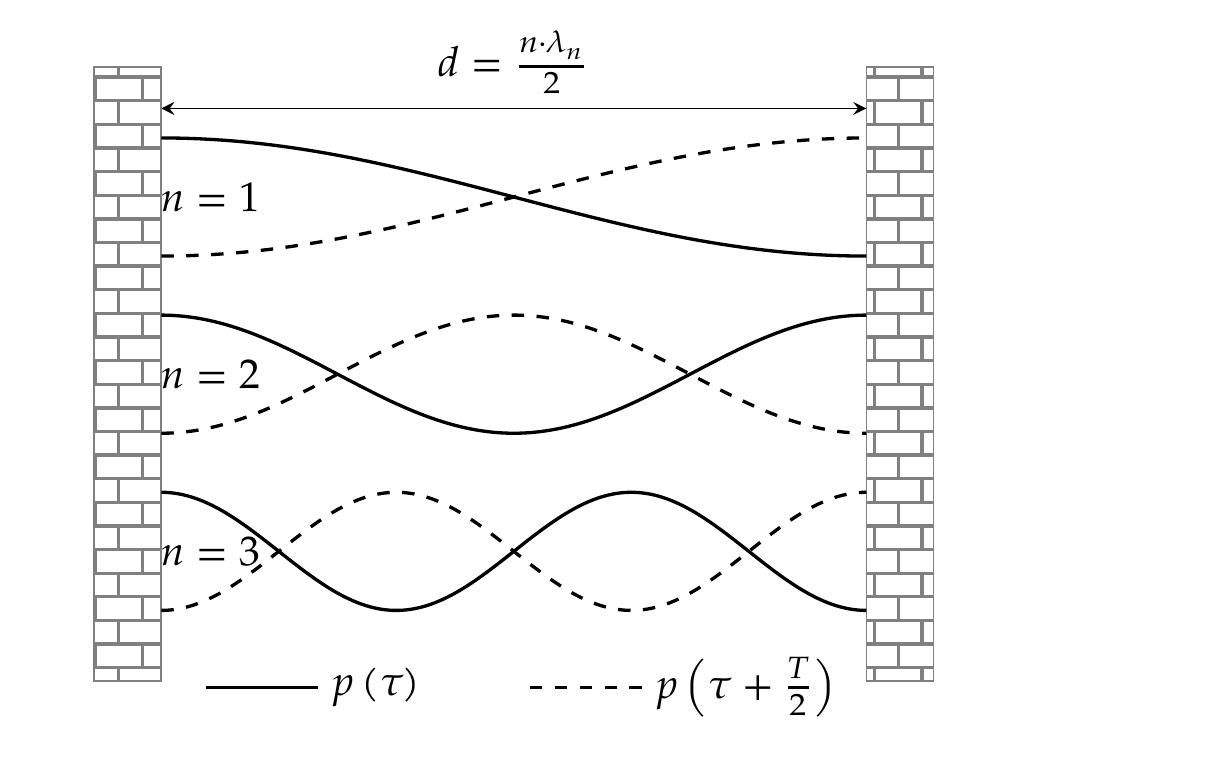
图1 两面平行墙之间的前三阶驻波声压分布
来源:MIT OCW 21M.380, Figure 4(Axial Mode 前三阶声压分布)
二、Room Mode:Axial / Tangential / Oblique
- Axial Mode 公式:fₙ = n·c/(2d), d = 对墙间距, n = 1,2,3…
- 例:5.0 × 4.0 × 2.8 m → f₁(L) ≈ 34.3 Hz, f₁(W) ≈ 42.9 Hz, f₁(H) ≈ 61.3 Hz
- Node:声压变化幅度最小位置;Antinode:变化幅度最大位置
- 真实房间:边界非完全刚性 + 有损耗/吸声/开口 → Node ≠ 静音,Antinode ≠ 恒定增益
|
方向 |
间距 d (m) |
f₁ (Hz) |
f₂ (Hz) |
f₃ (Hz) |
|
Length |
5.0 |
34.3 |
68.6 |
102.9 |
|
Width |
4.0 |
42.9 |
85.8 |
128.6 |
|
Height |
2.8 |
61.3 |
122.5 |
183.8 |
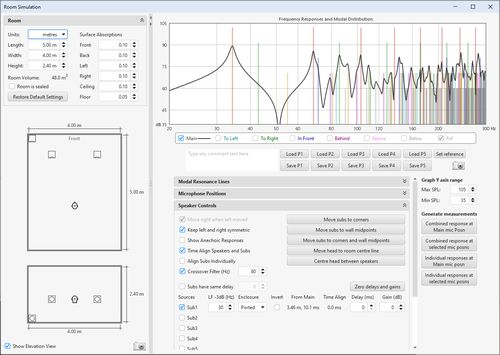
图2 Room Simulator:声源与接收位置对频率响应的影响
来源:Room EQ Wizard, Room Simulator
**Source + Receiver 位置共同决定实际响应:**
- Source 位置 → 决定各 Mode 被激发的相对强度
- Receiver 位置 → 决定接收到的 Mode 贡献比例
- 一个位置可能同时靠近某 Mode 的 Antinode 和另一 Mode 的 Node
- 尺寸计算 ≠ 实测峰谷:Boundary Impedance、Speaker Radiation、Position、Mode Overlap 全部影响最终结果
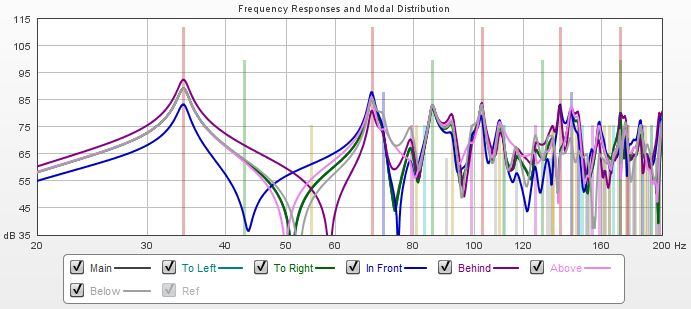
图3 多个相邻位置的低频响应差异
来源:Room EQ Wizard, Room Simulator
三、SBIR (Speaker Boundary Interference Response)
- 机制:Direct Sound + Reflected Sound 路程差 → 频率相关 Constructive/Destructive Interference
- Quarter-Wavelength 抵消:Speaker-to-Boundary 距离 = λ/4 时,该频率 Direct 与 Reflected 反相
- Boundary Gain:辐射空间减少 → 整体低频提升;SBIR → 与距离相关的频率凹口
- 两者可同时发生,但判断和处理方法不同
- **Deep Null 不宜用大幅 EQ 补偿**:Speaker Output ↑ → Direct + Reflected 同步 ↑,几何关系未变,Null 未必填平,Headroom 被消耗
- 优先级:Position Change > Absorption/Reflection Treatment > Limited EQ Correction
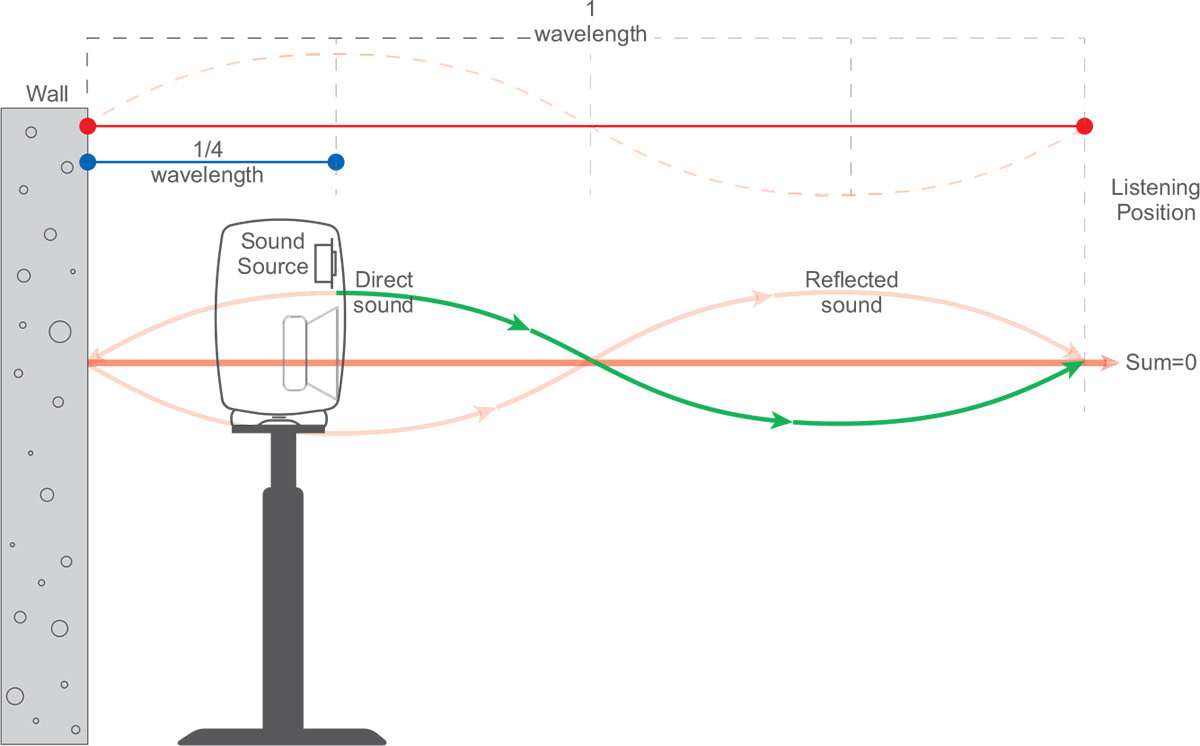
图4 SBIR 示意:后墙反射
来源:Genelec, How To Place Your Monitors
四、Listening Position → Mix Judgment
- Listening Position @ LF Peak → 频率显多 → Mix 时压低 → 换系统后该频段不足
- Listening Position @ LF Null → 频率显少 → Mix 时过度补偿 → 换系统后该频段过多
- {LQ}Room Center = Worst{RQ} / {LQ}Fixed Ratio = Best{RQ} 非普遍结论
- Geometric Center 与部分 Mode 的 Node/Antinode 重合,取决于 Mode Order & Direction
- Empirical Ratio → Starting Point → Multi-Position Measurement → Final Decision
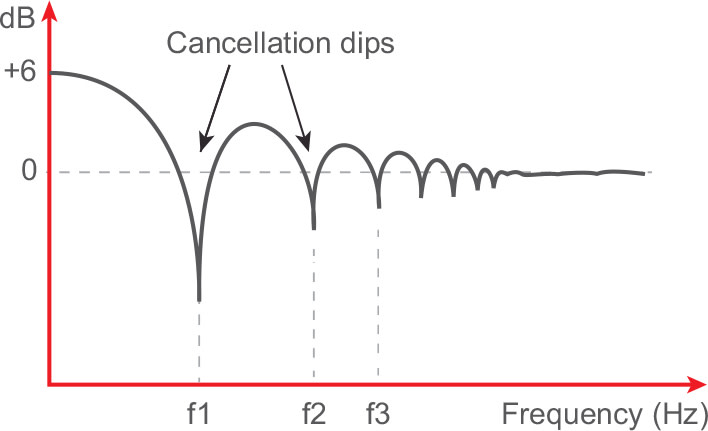
图 5 一次强反射可能形成一串抵消凹口
五、Recording End:Source Position vs. Mic Position
- Source Position → 决定 Room Mode 激发程度
- Mic Position → 决定 Direct/Modal/Reflected 比例
- Close Miking → 提高 Direct/Room 比,但 LF 变化仍可能来自 Proximity Effect
- Pressure-Gradient Mic(Figure-8 / Cardioid)近讲效应:距离 ↓ → LF ↑
- 不同乐器部位辐射不同频谱 → LF 变厚/变薄须分开判断:Room / Source Radiation / Mic Pattern / Distance
- Mic 靠近大面积反射面 → Direct + Delayed Reflection → Comb Filtering
六、Measurement & Diagnosis
- 先锁定具体频率,再比较多个位置的 Amplitude Response + Decay
- 测量要求:Omnidirectional Measurement Mic + Stable Test Signal + Acoustic Measurement Software
- 每次测量保持 Speaker / Volume / Crossover / Delay / Room State 一致
- 准确记录 Mic 坐标 + 高度;主监听位 + L/R/F/B + 实际坐人位
- 幅频曲线 → 强度分布;Waterfall / Decay Plot → 拖尾特征
- Single Peak → 可能 Modal;Deep Null → Modal Node / SBIR / Multi-Path Cancellation
|
诊断维度 |
工具/指标 |
模态特征 |
SBIR 特征 |
|
Amplitude Response |
REW / Smaart |
窄尖峰 |
深凹口 |
|
Time Domain |
Waterfall / Decay |
长拖尾(T60 > 1s) |
无明显拖尾 |
|
Spatial |
Multi-Position Compare |
强弱交替分布 |
与 Speaker-Boundary 距离相关 |
|
Treatment |
Position + Absorption |
Bass Trap + Position |
Position + Reflection Control |
七、Adjustment Priority & Multi-Sub Optimization
- Priority: Position Change > Reflection Control > Limited EQ
- Multi-Sub → 改善 Seat-to-Seat Uniformity,但无 Fixed Recipe
- Harman Research (Welti): 不同 Sub 配置在相同 LF Output 下 Seat Spread 差异显著
- 结论支持 Multi-Sub 作为优化手段,但配置须针对具体 Room/Seat/Modal 分布
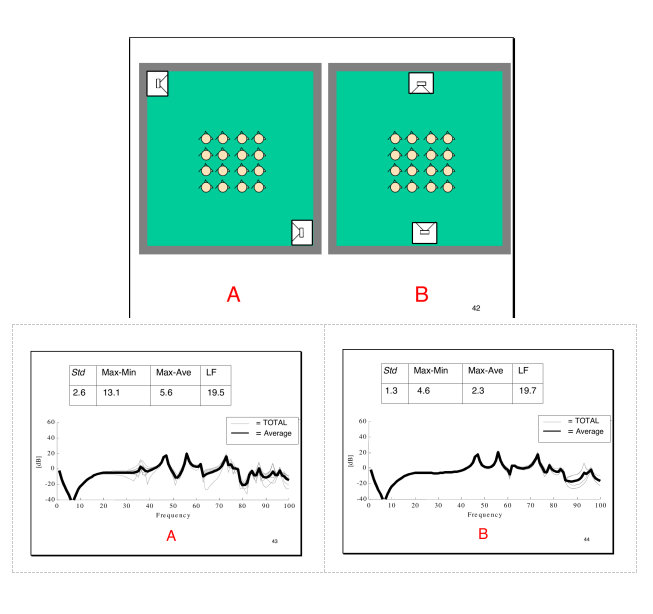
图6 两种低音单元配置的座位间响应差异
来源:Todd Welti, Harman International, Subwoofers: Optimum Number and Locations, p.43-44
八、Design Objective: Controlled & Verifiable Working Zone
- Room Mode + SBIR → 位置差异是物理事实,目标不是消除而是控制
- Control Room:Main Listening Position → Stable Mix Judgment;Adjacent Seats → 避免严重失衡
- Recording Space:明确哪些位置适合哪些 Source + Miking 方式,可重复
- 交付内容:Measurement Records + Position Coordinates + System Settings + Verification Results
涉及隔声性能、吸声效果或改造结论时,须标注依赖 Room Condition / Usage Target / On-site Verification,不作脱离条件的绝对承诺。
核查总表
|
核查项 |
核查内容 |
不查后果 |
|
Room Dimension |
三方向尺寸量取 + 轴向模态计算 |
低频峰谷无法预判 |
|
Modal Frequency |
实测 vs. 计算交叉验证 |
计算值与实际偏差大 |
|
SBIR Null |
Speaker-Boundary距离→抵消频率 |
特定频率深凹口被忽略 |
|
Multi-Position Sweep |
主位 + L/R/F/B + 实际座位 |
只看单点以为全房一样 |
|
Time Domain |
Waterfall / Decay Plot |
无法区分 Modal vs. SBIR |
|
EQ Range |
≤ 6 dB 补偿上限 |
大幅 EQ → Headroom 耗尽 |
|
Source Position Log |
录音时声源坐标记录 |
条件不可复现 |
|
Mic Distance/Pattern |
拾音距离 + 指向性 |
近讲效应误判为驻波 |
|
Deliverables |
测量记录 + 坐标 + 系统设置 + 验证结果 |
每次调试从零开始 |
资料来源
|
编号 |
来源 |
链接 |
|
1 |
MIT OCW 21M.380 Room Acoustics & Reverberation |
ocw.mit.edu |
|
2 |
ITU HSTP-SLD-Venue (2024) Appendix VIII |
itu.int |
|
3 |
Room EQ Wizard, Room Simulator |
roomeqwizard.com |
|
4 |
Genelec, How To Place Your Monitors |
genelec.com |
|
5 |
Genelec, GLM GRADE |
genelec.com/glm-grade |
|
6 |
D. Russell, PSU, Driving Room Modes |
acs.psu.edu |
|
7 |
T. Welti, Harman, Subwoofers: Optimum Number and Locations |
harman.com |
|
8 |
DPA, What is Close Miking |
dpamicrophones.com |


